
Living with a Power Wheelchair: Your Complete Guide to Home, Travel & Everyday Life
Getting your first power wheelchair is a turning point — one that opens up a whole new level of independence. But along with that freedom comes a learning curve that most people don't guide you through. The first time you try to turn around in your bathroom. The first time you need to get to a doctor's appointment across town. Nobody really walks you through that.
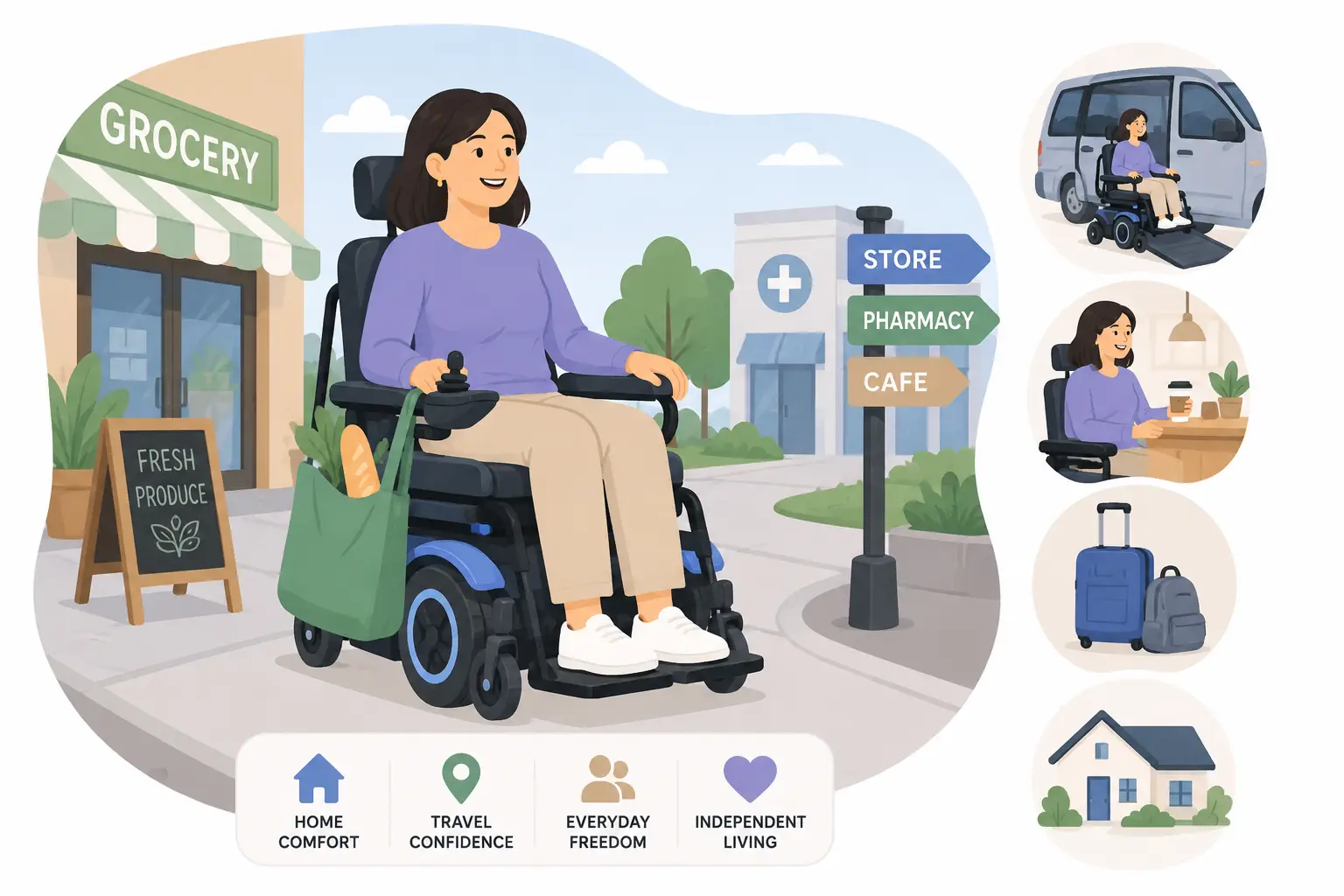
This guide is for people who just received their first power wheelchair, or who are about to. It’s also for family members and caregivers trying to understand what changes at home and how to help someone they love stay as independent as possible.
We’ll cover home setup, getting around cities like Los Angeles, domestic air travel, and the daily habits that make living with a power wheelchair go more smoothly — drawn from years of working with new wheelchair users across Southern California.
Your First Week at Home
The first few days at home feel overwhelming for almost everyone. That’s normal. Your brain is processing how to operate the joystick, how much turning space you need, and what used to be automatic, like walking through a doorway, now requires attention.
Give yourself time. Most people feel noticeably more comfortable with basic navigation within two weeks.
The doorway problem is usually the first thing that comes up. Standard interior doorways in most American homes are 28–30 inches wide. A power wheelchair is typically 24–26 inches wide. That sounds fine on paper. It’s much tighter in practice — especially in older homes where the doorframe takes up an inch on each side, and you’re still learning to steer at the same time.
If you’re hitting frames constantly, two things help. First, ask your DME supplier whether your joystick sensitivity can be adjusted — a quick programming change can make the chair respond more gradually, which gives you more control in tight spaces. Second, add rubber doorframe bumpers while you’re still learning. Most people stop needing them within a month.
Thresholds are worse than doorways. That small metal or wooden strip at the edge of a carpet, or where tile meets hardwood — a quarter inch of height becomes a real obstacle. A threshold ramp (sometimes called a transition ramp) costs $15–$40 and eliminates this entirely. Buy a few before the chair arrives.
Area rugs are your biggest hazard in week one. They bunch and catch. Pull them up, or tack them down flat. Wall-to-wall carpet is fine — it just adds rolling resistance, which shortens your battery range slightly.
Home Modifications That Actually Matter
Not every power wheelchair user needs a full home renovation. Many people make modest adjustments and manage well. What you actually need depends on your specific chair, your diagnosis, and how your home is laid out.
Ramps
If your home has even one step at the entrance, you're goin to need a ramp. A single 6-inch rise requires a ramp at least 6 feet long — that’s the 1:12 slope ratio the ADA uses as its standard. Portable aluminum ramps work well and don’t require a building permit. They’re also removable, which matters if you rent.
Two or more steps may require a more permanent solution. An occupational therapist who specializes in home accessibility can assess this and recommend a contractor.
Bathroom
This is where most modifications happen. A roll-in shower or a roll-under sink makes a real difference in daily independence. Grab bars are useful even if you transfer out of the chair to shower — they add safety during the transfer itself.
How close you can position the wheelchair next to the toilet matters enormously. Your physical or occupational therapist should assess this specifically, not generically. The right answer depends on which side you transfer from, your upper body strength, and your chair’s armrest style.
A Note on Older LA Homes
If you live in areas such as East LA, Boyle Heights, Compton, Inglewood, Pico-Union, or similar communities, your home was likely built before 1970. Pre-1970s construction in Los Angeles very commonly features 28-inch narrow interior doorways, sunken living rooms with a step down from the entryway, and hallways under 36 inches wide.
Widening a doorway runs $300–$900 depending on whether the wall is load-bearing. It’s one of the highest-value modifications for a power wheelchair user because narrow doorways create friction every single day — every trip to the kitchen, every bathroom visit.
Before you invest in construction, though, it's worth asking your DME supplier whether a narrower chair is an option. For instance, we carry a Group 3 power wheelchair with a narrow base that runs about 22.5 inches wide — which fits through a standard 28-inch doorway with room to spare. Whether you qualify depends on your diagnosis and functional needs, but if you do, it can solve the doorway problem entirely without touching a wall.
A Home Modification Assessment from a licensed occupational therapist will tell you exactly what needs to change and what doesn’t. Some Los Angeles nonprofits offer these assessments free or at low cost for Medicare patients. Your DME supplier or hospital discharge planner should be able to refer you to the right program.
Getting Around Los Angeles in a Power Wheelchair
Los Angeles isn’t always considered an accessible city. However, it is better than its reputation.
Access Services
Access Services is LA County’s paratransit program, required by the Americans with Disabilities Act. If your disability prevents you from using a fixed-route bus or rail line, you almost certainly qualify.
Here’s how it works: you schedule a ride — usually one to three days in advance — and an accessible van picks you up door to door. Drivers are trained to work with power wheelchairs and the securements that hold them in place. The fare is twice the standard LA Metro base fare, so roughly $3.50 each way as of 2025, which is still significantly cheaper than an accessible rideshare for most trips.
To apply, call Access Services at 1-800-827-0829 or go to accessla.org. You’ll go through a short eligibility assessment, which is usually done by phone or in person. Your physician or discharge planner can write a supporting letter, which often speeds the process up.
Access Services requires advance scheduling — it’s not on-demand. Build that into your planning. Medical appointments, therapy sessions, and errands all need to be booked ahead, typically by 5:00 p.m. the day before.
LA Metro
Every LA Metro rail station has elevator access. The practical caveat: elevators go out of service regularly. Before a rail trip that depends on an elevator, check the Metro Elevator & Escalator Status tool on metro.net or the Metro app. It updates in real time.
Metro buses have ramps and wheelchair securement systems. Operators are required by law to deploy the ramp when requested and to offer boarding assistance. If an operator refuses or fails to do this, you can report it through Metro’s customer care line. Document the bus number and route.
Reduced-fare TAP cards are available for Medicare recipients and people with disabilities. The application requires documentation — bring your Medicare card to any Metro Customer Center. The reduced fare cuts the standard fare roughly in half.
Rideshare and Accessible Taxis
Standard Uber and Lyft vehicles won’t accommodate most power wheelchairs. Both apps offer an “Accessible Vehicle” option, but availability in LA is uneven — better in higher-density neighborhoods, less reliable in the suburbs and the San Fernando Valley.
Yellow Cab LA (213-627-7000) has a wheelchair-accessible fleet and doesn’t require advance booking. Keep the number in your phone.
Flying Domestically with a Power Wheelchair
Flying with a power wheelchair takes planning, but it’s very doable.
Before You Book
Call the airline before you buy your ticket, not after. Tell them you’re traveling with a power wheelchair and give them the battery type (most modern power chairs use sealed lead-acid or lithium-ion batteries), along with the chair’s weight and dimensions. These are on your DME supplier’s documentation.
The Air Carrier Access Act requires airlines to transport your wheelchair. They cannot refuse it.
At the Airport
Arrive at least 30 minutes earlier than the airline’s standard recommendation. Check in at the counter — not a kiosk — so staff can tag your chair properly. A fragile tag and a “meet at gate” tag should go on the chair before it leaves your hands.
You’ll transfer to a narrow aisle chair at the gate and board before general passengers. Your power wheelchair goes in the cargo hold.
Take photos of the entire chair, the joystick unit, and all tilt and recline mechanisms. Write down your joystick speed and sensitivity settings, or have your DME supplier provide a settings sheet. If the chair is damaged in transit and needs reprogramming, you’ll need that documentation.
When You Land
Go straight to the gate agent when you deplane. Your chair should be brought to the jetbridge — not baggage claim. If it arrives damaged, document everything before you leave the airport. File a report at the airline counter the same day.
Airlines are liable for damage to mobility equipment under federal law. Keep your DME supplier’s paperwork — purchase price, equipment specs — somewhere accessible when you travel.
Everyday Life: Battery, Maintenance & Social Life
Battery Habits
Charge every night. Don’t wait until the battery is low before plugging in. Running a power wheelchair battery to empty regularly shortens its life — the same way it does with a phone. Full charge at the start of every day is the habit to build.
Most Medicare-category power wheelchairs offer 12–18 miles of range under normal conditions. Hills, rough sidewalks, and power seating systems (tilt, recline, elevated legrests) all reduce range. If you’re planning a long day out, charge fully beforehand and plan your route around that estimate.
If the battery starts draining significantly faster than it used to, that’s a sign the batteries need replacement — not a programming fix. Your DME supplier handles this under Medicare’s maintenance guidelines.
When Something Feels Off
Call your DME supplier. That’s what they’re there for. If the joystick feels sluggish, the chair pulls to one side, or you’re hearing new sounds from the drive system — don’t try to fix it yourself. A DME supplier is responsible for maintenance and repairs during the coverage period.
Keep the joystick and controller area dry. A joystick rain cover is cheap and protects the part most likely to fail from moisture.
Social Life
One thing that catches new users off guard: other people’s discomfort, not their own. Some friends and family members don’t know what to say, or they over-help in ways that feel infantilizing. That takes time to work through on both sides.
What most people find after a few months: the chair becomes background, not something you’re constantly thinking about. Social events get easier, not harder, because you’re no longer exhausted from trying to walk distances your body can’t handle. Many people in power wheelchairs attend more events than they did before — not fewer — once they have equipment that actually assists them.
Why the Right Chair Changes Everything
Not every power wheelchair is the same. This is worth saying directly, because it gets missed.
A basic power wheelchair moves you from point A to point B. But if your diagnosis involves pressure injury risk, postural instability, circulation issues, or fatigue — conditions common in MS, ALS, spinal cord injuries, muscular dystrophy, and several others — you need features that go beyond basic drive.
Tilt and recline redistribute pressure and prevent skin breakdown. For many diagnoses, they’re not upgrades. They’re clinical requirements written into the medical literature.
Elevated legrests are critical for patients with lower-limb edema, circulation problems, or certain spinal conditions. Sitting in a standard position for hours causes real, measurable harm without them.
We’ve seen patients come to us after being discharged with a wheelchair that was too small for their body, had no tilt, no recline, no elevating legrests — because those features weren’t included in the original order. The referring provider wasn’t asked the right questions, or the supplier never looked beyond the basic mobility diagnosis.
That’s not a small gap. Wrong equipment leads to daily pressure injuries, secondary pain, and in some cases hospitalizations that could have been avoided entirely with the right chair from the start.
When a DME supplier works directly with your physician or discharge planner — asking about your diagnosis, your daily routine, your home layout — the equipment they order actually matches your life. That’s what the process is supposed to look like.
Frequently Asked Questions
Does Medicare cover a power wheelchair?
Yes, Medicare Part B covers power wheelchairs (power-operated vehicles and power mobility devices) when your doctor documents that you have a mobility limitation that significantly impairs your ability to perform activities of daily living inside your home, and that a power wheelchair is medically necessary. Prior authorization is required for most power mobility devices.
How long does it take to get used to a power wheelchair?
Most people feel comfortable with basic indoor navigation within one to two weeks. Outdoor use — curb cuts, uneven surfaces, tight spaces in public — typically takes another two to four weeks to feel natural. Your DME supplier can adjust joystick sensitivity during this period to match where you are in the learning curve.
What happens if my power wheelchair breaks down while I’m out?
Call your DME supplier first — they handle repairs under Medicare’s maintenance guidelines during the coverage period. Keep their number in your phone. For immediate situations, Access Services can dispatch a vehicle if you’re stranded, though this requires a call and some wait time. Carrying a portable charger for the joystick controller and knowing your battery range before leaving home prevents most breakdown situations.
Can I take my power wheelchair on an airplane?
Yes. The Air Carrier Access Act requires airlines to transport your power wheelchair at no additional charge. Call the airline before booking to provide your chair’s dimensions, weight, and battery type. Arrive early, check in at the counter, and document the chair’s condition with photos before handing it over at the gate.
What is a Group 3 power wheelchair and do I need one?
Medicare classifies power wheelchairs by group based on the user’s clinical needs. Group 3 chairs are designed for patients with more complex medical conditions — they typically include power seating features like tilt, recline, and elevating legrests, and are built for higher usage demands. Whether you qualify depends on your diagnosis and functional assessment. Your physician and DME supplier determine the appropriate group together based on your medical documentation.
If you’re a Medicare patient in the Los Angeles area, Feroz Medical works directly with your physician, discharge planner, or case manager to find the right fit — not just the standard option. We handle prior authorization, coordinate with your care team, and deliver and set up your equipment at home. Call our team or send a referral →
- Access Services (LA County paratransit) — accessla.org
- ADA Access Board — Ramps & Curb Ramps Guide
- Air Carrier Access Act — U.S. DOT Disability Bill of Rights
- LA Metro — metrola.net
- LA Metro — Reduced Fare TAP Cards
- PICF — HUD Older Adult Home Modification Program