
Most transfer injuries don't happen because a caregiver lacks strength. Training and technique are what strongly influence transfer safety — and this guide covers every major method, from stand-pivot to mechanical lift.
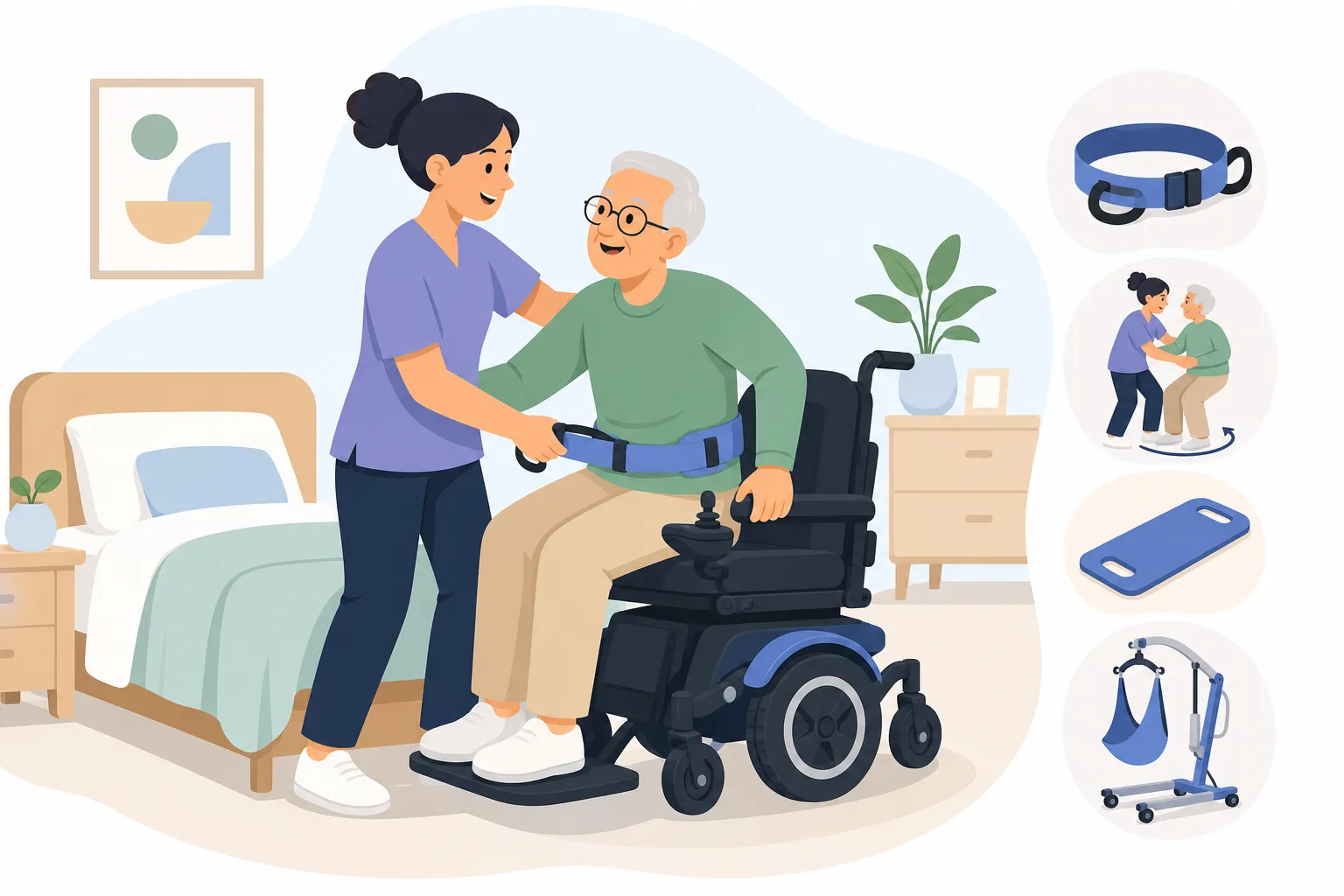
Learning how to move someone from bed to wheelchair safely is one of the most important skills any caregiver can develop. Most transfer injuries don't occur because a caregiver lacks strength — training and technique are what strongly influence transfer safety.
Moving someone from a bed to a wheelchair every single day is physically and mentally demanding work, and when you're doing it without the right technique, the strain adds up fast. According to the CDC, nearly 1 in 5 caregivers reports fair or poor health —, and the World Health Organization reports that up to 72% of nurses worldwide suffer from chronic low back pain, most of it linked to lifting, transferring, and repositioning patients.
This guide breaks down every major transfer method in a straightforward, method-by-method format. Whether your family member can bear some weight or none at all, you'll leave here knowing which approach fits the situation, how to execute it safely, and what to check before the patient moves an inch. One thing most caregivers discover too late: the wheelchair itself is part of the safety equation. A chair that isn't fitted correctly makes every transfer harder — we'll come back to that.
Preparation is where most transfers succeed or fail. A caregiver who rushes into a transfer without checking the environment and the patient's status is starting with a significant disadvantage. A brief preparation period protects both people — not just the patient — and that habit pays off every single time.
Place the wheelchair parallel to the bed or at a slight angle toward the patient's stronger side, with both the wheelchair brakes and the bed brakes fully locked. Remove the footrests completely or swing them out of the transfer path. If the armrest on the side closest to the bed is removable, take it off. For most power wheelchairs, you're able to flip them up easily. A wheelchair with fixed armrests or a seat that's the wrong height for this patient will make this step awkward and force the caregiver into poor body positioning before the transfer even begins.
Position the gait belt — sometimes called a transfer belt — at or just below the patient's natural waist, over clothing, with the buckle in front and the teeth pointing inward toward the patient's midline. The belt should be snug enough that only two fingers slide underneath. Use an underhand grip (palm facing up) on the belt when guiding the transfer. Grabbing clothing instead of a belt provides far less control and is not recommended; it forces the caregiver's hands into awkward positions and reduces stability at the most critical point of the move.
Before the patient stands, confirm they can sit at the edge of the bed with reasonable trunk stability, and test quadriceps strength by asking for a straight-leg raise. Check for dizziness when they sit upright, especially in patients recovering from illness, blood loss, or extended bed rest, as blood pressure drops can cause sudden lightheadedness. Identify any contraindications to belt placement: PEG tubes, colostomy bags, and open abdominal wounds all require the belt to be repositioned or a different method used entirely.
This is the non-negotiable foundation of every safe bed-to-wheelchair transfer. The two movements that cause most caregiver injuries are bending at the waist and twisting simultaneously under load. Your spine is not built to handle that combination.
Stand with your feet shoulder-width apart and one foot slightly forward for directional stability. Keep your back straight with a slight natural arch (neutral spine), and bend at the hips and knees rather than the waist. Before any movement begins, engage your core by contracting your abdominal muscles. Keep the patient's weight as close to your own body as possible throughout the transfer. The farther the load is from your center, the more force is applied to your lower back, which you don't want at all.
According to NIOSH guidance, twisting at the waist while bearing load is a major cause of disc injuries during patient transfers. The correct technique is to move your feet first and let your hips and shoulders follow as a unit. Plan the entire transfer path before you start so there are no mid-move corrections. If the room setup forces an awkward pivot angle, rearrange the furniture before the transfer. A 30-second room adjustment is always worth it.
The stand-pivot method works for patients who can partially bear weight through their legs and follow simple instructions. It's a commonly used technique in home care settings, and with the right step-by-step approach, most caregivers can learn it reliably.
Roll the patient onto their side facing the wheelchair, position their knees toward the edge, and swing their legs off the bed while using the momentum to help them sit up. Lower the bed (if possible) so the patient's feet are flat on the floor with no dangling or tiptoes. Stabilize the patient at the seated edge before any attempt to stand, and confirm they aren't dizzy before proceeding.
Once the patient's legs make contact with the seat front, begin the controlled descent: shift your weight from your back foot to your front foot, bend your knees, and guide the patient's hands toward the armrests. Do not lower them until you feel that contact with the seat. Reposition the patient well back in the seat for proper weight distribution, reattach the footrests, and remove the gait belt only after the patient is fully stable and settled.
Not every patient can stand, even briefly. For those with significant leg weakness, paralysis, or lower-limb amputation, the slide board transfer is often the right tool. Some caregivers are unfamiliar with transfer boards until introduced by a clinician or DME specialist — if this is new to you, it's worth asking about at your next clinical visit.
The slide board is appropriate for stroke survivors with significant leg weakness, people with spinal cord injuries, MS, or above-knee or below-knee amputations. The key qualifier is upper body stability: the patient doesn't need to stand, but they need to support some weight through their arms. If a patient has both lower extremity weakness and poor upper body function, a mechanical lift is the more appropriate choice.
Position the wheelchair at a slight angle to the bed, lock the brakes, and remove the nearest armrest. Slide one end of the board under the patient's thigh and angle the other end onto the wheelchair seat toward the far back corner. Guide the patient through short lateral movements, leaning their head and shoulders opposite the direction of travel. The caregiver's role here is to assist and stabilize, not to lift. Because the board distributes horizontal load across its surface rather than requiring the caregiver to bear it, this technique can work for solo caregivers — provided the patient has enough arm strength to assist with the lateral movement. For a clear demonstration, review guidance on using a transfer sliding board.
Knowing when to escalate is a skill, not a failure. Experienced clinicians make this call every day based on the patient's functional status. Having clear criteria removes the guesswork from the decision.
A solo manual transfer is not appropriate when the patient cannot bear any weight, has unpredictable muscle tone or spasticity, is cognitively unable to follow one- to two-step instructions, or when the caregiver would need to manage more than 35 pounds of the patient's weight alone (the NIOSH recommended maximum). If a stand-pivot begins to go wrong, stopping and calling for help is always the safer path — a controlled pause carries far less risk than an uncontrolled partial fall.
A Hoyer lift transfer involves placing the appropriate sling under the patient while they're in bed, attaching it to the lift frame, raising the patient until their weight clears the surface, repositioning over the wheelchair, and lowering slowly. Sling selection matters: a divided-leg or U-sling works well for most bed-to-wheelchair transfers, and the sling must match the patient's weight capacity and body shape. For patients who are cooperative but heavy or have poor trunk control, a two-person assist is the safer choice even with a lift — the second person helps with sling positioning and patient stability throughout the move. Your home health agency or DME supplier can advise on which lift type and sling configuration fits the patient's specific situation. See the state guidance on how to use a Hoyer lift for detailed sling and positioning tips.
The wheelchair is a key variable that caregivers rarely think about when evaluating transfer difficulty. For instance, a seat that's too high, or missing the right armrest configuration creates mechanical disadvantages that compound with every transfer. Getting this right is part of the safety plan.
Seat height directly affects whether the patient's feet are flat on the floor during the stand-up phase. If the seat is too high, the patient's feet dangle; if it's too low, rising requires more lower-extremity strength than the patient may have. Seat depth impacts how well the patient is supported after lowering, which affects posture and stability. Armrest height and removability determine whether the caregiver can clear the transfer path cleanly or has to work around an obstacle on every single transfer.
If the patient uses a power wheelchair with seat elevation, tilt-in-space, or power recline, those features exist partly to make transfers safer and easier. Most caregivers don't think to touch them during transfers, but they can make the process ten times easier.
Here's what each key feature does during a transfer:
Seat elevation allows the seat to raiase to a near-bed height before the transfer begins. Instead of lifting the patient up to the seat, you're guiding them sideways at roughly the same level. The difference in physical effort for both caregiver and patient is dramatic. For someone with minimal lower extremity strength, this can mean the difference between needing to stand fully and barely needing to bear weight at all. Once the patient is seated, lower the seat back to the appropriate position for the day.
Tilt-in-space tilts the entire seating system backward as a unit, shifting the patient's center of gravity toward the back of the chair. During a transfer, a slight tilt before the patient sits can help position them for a cleaner pivot. Once they're seated — especially if they've landed a little forward or off-center — tilting back uses gravity to slide them naturally into a proper seated position rather than having to pull and push them manually. It also prevents that immediate post-transfer problem where someone who's just been lowered into the chair immediately starts sliding forward.
Don't be hesitant to use these features. These are everyday functions, and using them during transfers is exactly what they're designed for.
A clinical wheelchair evaluation performed by a certified Assistive Technology Professional (ATP) accounts for the patient's exact body measurements, home environment, and day-to-day life before any equipment is ordered. At Feroz Medical Supplies, our team works directly with patients, caregivers, and referring clinicians across the Los Angeles and Southern California area to configure wheelchairs around each patient's clinical profile — not just a standard catalog size. For Medicare-eligible patients, custom wheelchair configurations may be covered under Medicare Part B, subject to medical necessity criteria; we recommend confirming coverage details with your provider or reviewing CMS guidelines directly. A chair built around the patient's actual needs reduces the physical demand on the individual, including the caregiver.
Safe transfers are a skill, not an innate physical ability. The right preparation, sound body mechanics, and the correct method for the patient's current functional level are what separate a routine transfer from an injury. Each section of this guide gives you something concrete to apply immediately — return to the stand-pivot, slide board, and lift sections as needed, since the right starting point depends on how much weight the patient can bear.
If transfers feel harder than they should, the equipment is worth examining. A wheelchair that wasn't matched to the patient's body or transfer needs adds resistance at every step. If that sounds familiar, it's worth reaching out to a Medicare-approved DME supplier for a clinical evaluation. For a quick comparison to help decide between manual and powered options, see Power Chair vs Manual Wheelchair: Which Is Right for You? The goal isn't a better wheelchair for its own sake — it's a safer, more sustainable daily routine for the patient and everyone supporting them.
Feroz Medical is an accredited and Medicare-approved complex rehab technology and durable medical equipment supplier, partnering with patients and physicians across Los Angeles and Southern California since 2002. If you're evaluating wheelchair options or have general questions on transfer equipment, our experienced team handles everything from the clinical evaluation — to delivery, and keeps you informed throughout. Reach Out to Us →