
Choosing between a power chair and a manual wheelchair is one of the most consequential mobility decisions you'll make — and the right answer depends on your body, your home, and your daily routine.
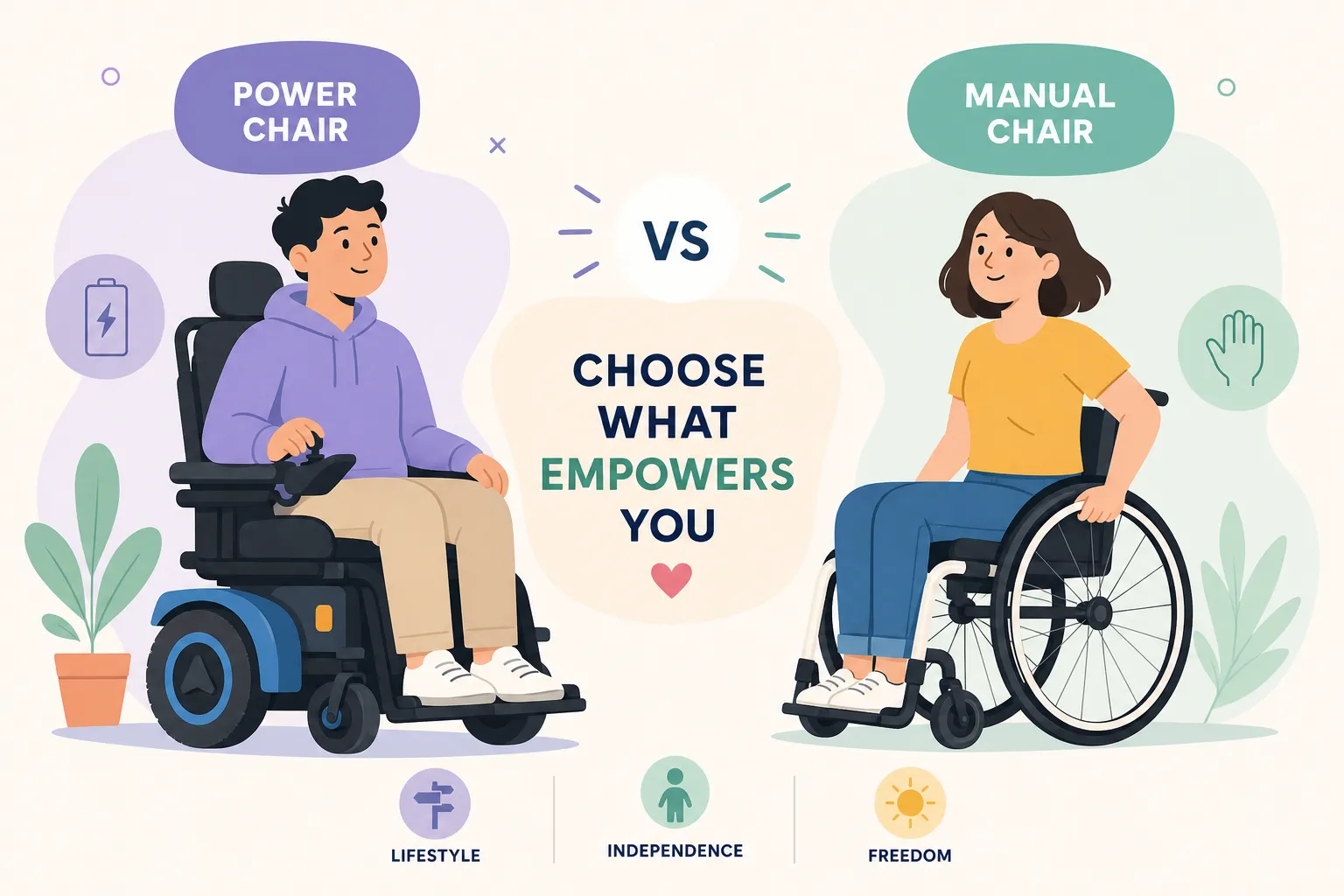
One option folds into your car trunk. The other could carry you across six city blocks without breaking a sweat. Both come with a stack of questions you may have not considered.
This decision touches every part of your daily life: how far you travel, who you live with, what your home looks like inside, and what your body can actually sustain over years of use. This isn't a preference conversation — it's a clinical one, and the right answer looks different for every person who asks it.
Physical condition, home layout, insurance eligibility, and daily routine all shape the outcome. At Feroz Medical Supplies in Los Angeles, our experienced specialists and RESNA-certified ATPs work through these variables with patients and their physicians constantly, turning a confusing comparison into a covered, clinically appropriate solution. Here's what you need to know before that conversation happens.
A manual wheelchair moves because you physically push it, either by gripping the wheels yourself or with a caregiver behind the handles. A power chair moves because a battery-driven motor responds to a joystick or alternative input device. That difference matters more than most people realize. For someone with adequate arm strength, self-propulsion may be functional and sustainable. For someone with ALS, MS, or significant upper-body weakness, it's neither. Relying on a caregiver for every movement isn't independence — it's a workaround.
Manual chairs typically weigh between 15 and 50 pounds and fold into a standard car trunk in under a minute. Many power chairs are significantly heavier and often require a vehicle lift or wheelchair-accessible vehicle.
Transportability is the first practical filter worth applying to your own situation, because a chair that can't get to your destination isn't useful no matter how well it performs indoors or outdoors. If you rely on frequent out-of-home trips or don't have access to a lift-equipped vehicle, factor that in early.
Most power wheelchairs deliver up to 20 miles per charge, with recharge times of around 8 hours — making overnight charging the standard habit for most users. For active users, that trade-off is more than worth it. Pushing a manual chair through a full day of errands, appointments, or outings can wear you out — or worse, put you at risk of injury. A power wheelchair removes that ceiling entirely, letting you stay independent and active for as long as your day demands.
Conditions like ALS, multiple sclerosis, muscular dystrophy, spinal cord injury, severe rheumatoid arthritis, and cardiopulmonary disease make sustained manual propulsion either unsafe or physically impossible. What often goes overlooked is the cumulative damage: repetitive wheelchair propulsion is a well-documented cause of shoulder injury among long-term manual wheelchair users. Someone who can self-propel today may not be able to do so safely in a couple of years, and by then, the shoulder damage is already done.
Users who lack trunk control or require tilt, recline, or seat elevation to maintain posture and skin integrity need features that simply aren't available on manual chairs. Medicare classifies these as Group 3 Complex Rehab Technology (CRT) power chairs, and they require a separate qualification process including a RESNA-certied ATP seating evaluation.
Medicare's documentation requirements for complex rehab technology are more involved than a standard power wheelchair, but for users who genuinely need these features, the coverage pathway exists and is absolutely worth pursuing.
Medicare uses mobility-related activities of daily living (MRADLs) as the benchmark for power chair qualification. These are the tasks performed inside the home: moving to the bathroom, getting to the kitchen, accessing different rooms. If someone cannot complete these activities safely using a manual chair, a power chair may be both clinically appropriate and covered under Part B.
But beyond the clinical criteria, a power wheelchair can genuinely give someone their life back. For instance, features like seat elevation let users reach shelves, countertops, and cabinets on their own. Tilt and recline allow for repositioning without needing assistance. For someone who prioritizes independence, the right power chair makes living on their own terms actually possible.
For users with adequate arm strength and cardiovascular endurance, a manual chair offers real advantages: it's lighter, easier to transport, and provides built-in physical activity through self-propulsion. For example, someone recovering from orthopedic surgery, managing a stable neurological condition, or living with a partial mobility impairment may be better in a manual wheelchair. The key word is “adequate.” If propulsion is genuinely sustainable without shoulder risk, manual often wins on practicality.
An ultralight manual chair folds into a sedan trunk and fits through most doorways without issue. For instance, nn the LA Metro or inside a compact apartment, maneuverability matters. Power chairs, even mid-size models, may struggle with very narrow hallways, tight bathroom doors, and small elevator spaces. If most of your daily movement happens within a contained environment and you have a vehicle without a lift, the manual chair's smaller footprint is a meaningful advantage.
When insurance coverage isn't in play, or a user doesn't meet the medical necessity threshold for a power chair, the cost gap is significant. For instance, custom lightweight models reach to about $2,500, whereas custom power chairs without coverage run well over $30,000 for advanced CRT configurations. For buyers without qualifying coverage, that difference is the deciding factor before anything else.
Los Angeles presents a specific set of terrain challenges that shape the power chair vs manual chair decision in practical ways. Cracked sidewalks, steep driveways, missing curb cuts, and ground movement from geological faults create surfaces that change constantly. Power chairs, especially front-wheel drive models, handle inclines and rough ground far better than manual chairs, and for users covering multiple blocks daily, motor torque and terrain clearance matter in ways that never appear on a spec sheet. Downtown and hillside neighborhoods in particular favor a motorized solution.
Users who run errands, attend medical appointments, or commute daily benefit from a power chair's ability to sustain mobility without physical fatigue. A manual chair user who exhausts their arm strength halfway through a grocery trip loses independence at exactly the wrong moment. Fatigue accumulates over a full day in ways that a single test ride doesn't reveal, which is one reason an evaluation assesses daily routine rather than just immediate ability.
An indvidiual who moves primarily within a single-floor apartment and loads their chair into a standard vehicle, portability becomes the primary value driver. Battery range is irrelevant if the car has no lift or ramp. Wide turning radius matters when the hallway is 30 inches across. In this scenario, the manual chair wins on fit, not just cost, and forcing a power chair into that environment creates more problems than it solves.
Medicare Part B covers 80% of the approved cost after the annual deductible once medical necessity is established. Beneficiaries typically owe the remaining 20% coinsurance plus any unmet deductible, unless they carry supplemental or secondary coverage. For a Group 3 power chair, the process includes prior authorization plus a face-to-face physician exam and an ATP-certified seating evaluation. Beneficiaries with supplemental coverage typically have little to no remaining out-of-pocket cost once approved.
Denials happen most often because the clinical documentation doesn't meet Medicare's specific language requirements — not because the patient doesn't genuinely need the equipment. The physician's notes, the functional assessment, and the prior authorization submission all need to speak Medicare's language precisely. Working with a DME supplier who manages this process end-to-end changes outcomes. At Feroz Medical, documentation management is built into the intake process from the first referral, giving patients a structured path through authorization rather than navigating it alone.
You live in a second-floor LA apartment with no elevator or ramp.
Manual, assuming you can transfer. A power chair can't navigate stairs safely, and the weight makes lifting it impossible for most people. If you can't transfer, the housing situation itself is the barrier, and that's a separate conversation.
You have MS and your energy is reliably gone by early afternoon.
Power chair. MS fatigue isn't ordinary tiredness — it's a neurological phenomenon that can make arm movement genuinely difficult by mid-afternoon on a bad day. Asking someone experiencing MS fatigue to push a manual chair daily is detrimental to their physical well-being.
You drive yourself to work in a standard sedan.
Manual. Driving a power chair independently into a standard car are prohibitive enough that most people eventually get a van or stop driving. Neither of those may be what you want.
Your main use is your neighborhood: pharmacy, grocery store, a few blocks each way.
It depends on which neighborhood. Two blocks on a flat, maintained sidewalk with working curb cuts may be fine for manual. Five blocks on heaving concrete with two missing curb cuts and a parking lot to cross is a different trip entirely, and a power wheelchair will help tremendously.
A stroke affected your arm and you need the chair primarily at home.
Power chair, likely with a modified joystick configuration. An ATP evaluation matters specifically here because it determines which control interface matches your actual remaining function — and there are options beyond the standard joystick, such as head arrays for more severe arm involvement.
You're a caregiver for a family member who has difficulty transferring and can't self-propel.
A power wheelchair is likely the right fit. Features like attendant controls and tilt-and-recline systems make transfers safer and significantly reduce the physical demand on caregivers — especially for those providing care for long stretches throughout the day. But beyond the practical benefits for the caregiver, a power wheelchair gives the person receiving care something equally important: a sense of independence. Being able to move through their own home on their own terms, without always relying on someone else, makes a real difference in quality of life.
An Assistive Technology Professional evaluation is a structured clinical process, not a quick appointment. It includes an assessment of seated posture, upper-body strength, range of motion, trunk stability, skin integrity, home environment measurements, and daily routine. A mat examination identifies skeletal alignment and support surface requirements. Equipment trials may be done to allow the ATP to test configurations before finalizing recommendations. The evaluation produces the documentation Medicare needs to approve the right equipment, which is exactly why it's required for CRT-class power chairs.
Feroz Medical's specialists and ATPs conduct these evaluations as part of their full-service intake, working directly with referring physicians to build the clinical case and manage insurance authorization from start to finish. The goal is a chair that perfectly fits the patient's body, their home, and their daily lives — delivered with hands-on training and dedicated follow-up support.
The right chair doesn't come from browsing product photos. It comes from a physician's documentation, an ATP's clinical assessment, and a supplier who understands how to turn that evaluation into approved, delivered equipment. If you're weighing a power chair vs manual chair, start with your doctor, ask for a referral to an accredited CRT and DME supplier, and let the clinical team match the equipment to your actual life.
The power chair vs manual chair decision is never one-size-fits-all. One person's ideal solution is another person's wrong fit, and the difference shows up in their body, their daily routine, their living situation, and their insurance eligibility. What looks like a simple mobility chair comparison is actually a clinical determination that requires the right people asking the right questions.
If you're in Southern California and working through this decision, the team at Feroz Medical is ready to help. We have guided patients and referring physicians across Los Angeles and Southern California for over two decades. Reach out to our team for guidance on finding the right wheelchair for you.
Feroz Medical is an accredited and Medicare-approved complex rehab technology and durable medical equipment supplier, partnering with patients and physicians across Los Angeles and Southern California since 2002. If you're evaluating power mobility or custom seating options, our experienced team handles everything from the insurance process — to delivery, and keeps you informed throughout. Reach Out to Us →